
Legacy article
Shaping How People Behave: Designing the Full Journey, Not Just the Moment
Shaping how people behave through system-level behavioral design in tourism. Learn how destinations guide better choices across the full journey.
- Author
- By Milena Nikolova
- Published
- November 28, 2025
This article was migrated from the BehaviorSMART archive with its original legacy context.
Travel unfolds across a web of touchpoints – booking channels, transport, hosts, guides, trails, restaurants, and shared public spaces. Each one influences behavior, often without intention. This piece invites a shift in mindset: from nudging individuals to designing systems that guide visitors toward behaviors that protect places, enhance experiences, and create value. Using insights from our work in Arctic Europe, it argues that the next frontier in travel is not more messaging, but embedding behavioral design into the fabric of entire environments.
Every now and then, our team finds itself returning to the same question: What does it truly take to scale behavior change in travel? Not the well-intended nudge at the hotel breakfast table or the polite reminder at a trailhead, but something far more systemic. How do you influence behavior across an entire destination, over the course of days or weeks, across dozens of touchpoints, and across travelers who arrive with different cultures, habits, expectations, and motivations?
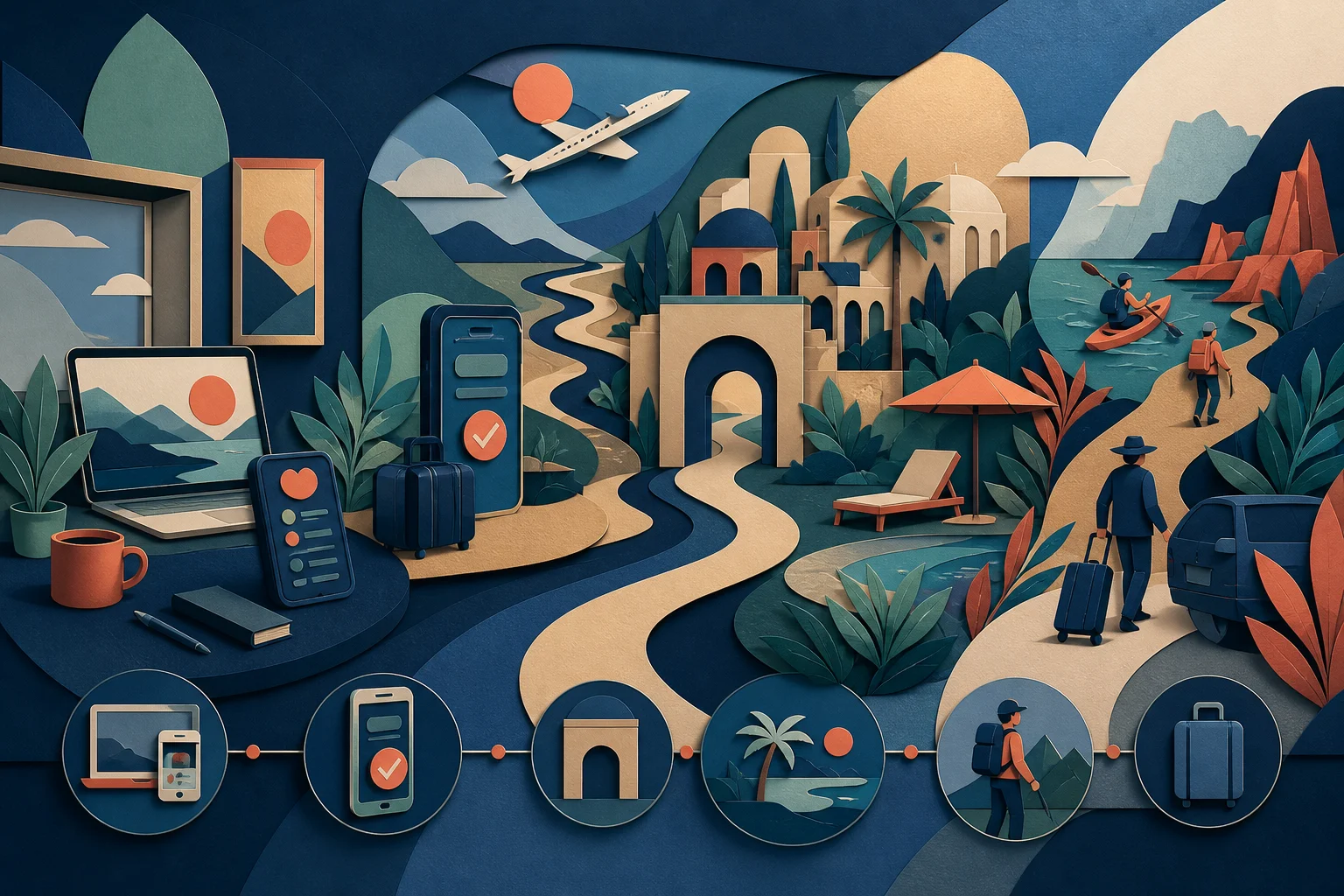
Travel is unlike most other industries because the guest journey unfolds over time, space, and context. A traveler moves through a long chain of interactions with booking platforms, websites, transport providers, hosts, guides, restaurants, visitor centres, trails, attractions, public spaces, and, of course, residents and other visitors. Each of these touchpoints subtly shapes behavior, intentionally or not. And once you notice this, the question becomes hard to ignore: If the environment is always influencing behavior anyway, shouldn’t we plan that influence with intention?
This way of thinking became especially vivid in our work with the Arctic Europe Tourism Cluster. On paper, the task was straightforward: co-develop a Code of Conduct that would articulate shared expectations for visitor behavior in a region of exceptional beauty and ecological fragility. But a meaningful code cannot simply express values. It must translate principles like “respect nature” into concrete, observable behaviors and into clear guidance for how visitors can enact those behaviors in real conditions.
That required working backwards from specific actions that threaten Arctic ecosystems – walking off trail, disturbing wildlife, damaging vegetation – and defining what “good behavior” actually looks like instead. These became the Golden Standard Norms that describe what responsible behavior means in Arctic conditions.
Yet the moment those desired behaviors are defined, a much bigger challenge reveals itself: how do you make them happen with intention? How do you move beyond the code as a document and instead weave its principles into the design of the entire destination ecosystem? Identifying desired behaviors is not the final destination; it is the starting point for reprogramming a system so that the behaviors a place values are consistently, creatively, and almost effortlessly reinforced by every actor across the supply chain.
In exploring this, we quickly saw that system-level influence is already happening everywhere – just rarely by design. A guide’s briefing, a hotel lobby display, a booking confirmation email, an OTA description, a trail sign, a restaurant menu, a moment of storytelling on a hike, even the way a path or viewpoint is laid out… each of these moments has the power either to support the desired behavioral direction or to quietly push against it. Together, they form the behavioral architecture of the destination.
Take one of the Golden Standard Norms we worked with as an example: exploring Arctic nature while leaving no trace behind. One specific behavior within this is appreciating the landscape without picking or damaging plants. Simple on the surface, but in practice deeply shaped by habits, cultural norms, and gaps in awareness. Many visitors do not understand that Arctic flora can take decades to recover from disturbance. Some come from environments where picking flowers in nature is harmless. Others still assume that “just one stem” cannot possibly matter. In this reality, the challenge goes much beyond persuading people to care – it is ensuring that the service system consistently guides them toward the right choice, even when they are in a new environment, operating on autopilot, or simply not mindful of consequences.
Employing intentional behavioral architecture requires aligning cues, messages, and experience design across choice points along the entire journey. Before arrival, websites and travel materials clearly frame what “appreciate without picking” means in Arctic conditions. Upon arrival, accommodation providers integrate these norms into their guest touchpoints. During experiences, guides activate awareness through storytelling and local knowledge, turning a desired norm into part of the experience, perhaps through challenges to spot, photograph, or learn about rare plant species without touching them. Outdoor path designs and signage offer clarity and remind visitors to enjoy the beauty without disrupting it. And because these cues are consistent throughout the system, they crystallize into a social norm: visitors understand what is expected without a doubt, and they sense that others understand it too, so misbehavior will not easily be mistaken for absentmindedness.
This is the core of programming good behavior into a destination system. It goes far beyond establishing rules and toward designing an environment that animates those rules, making good behaviors the most natural, engaging, and socially reinforced choices. When every part of the system pulls in the same direction, behavior change stops being an individual effort and becomes a collective pattern.
More and more, I believe this is where our industry needs to move. Nudges at isolated touchpoints have already demonstrated the power of behavior-smart thinking and shaping how people behave. The next step is scaling these approaches beyond the single moment or individual decision. The pressures on fragile places, the expectations of travelers, and the realities of sustainability demand more deliberate and integrated approaches. Businesses and their supply partners can no longer rely on hope or mere information; they must shape the behaviors they value through thoughtful design, contextual cues, and coherent guest journeys that make good behavior frictionless from the start of the journey to its end.
Destinations, too, need to go beyond encouragement to create environments where guests naturally gravitate toward what benefits the place – low-impact activities, mindful consumption, respectful engagement, and support for local value creation. And the logic extends even further: cities can embed choice design that encourages movement, social connection, waste reduction, and behaviors aligned with local wellbeing and culture, while simultaneously setting the stage for healthier, more meaningful visitor experiences.
We are entering a phase in travel where asking visitors to behave well is no longer sufficient, especially as visitor flows continue to grow. We need to design systems that lead them there. The future of responsible tourism lies in programming good behavior into the fabric of business systems and places so that every product, every service, every encounter, and every moment reinforces the norms that protect what makes a destination worth visiting in the first place.
If these ideas resonate and you are exploring how your organisation, destination, or city might apply system-level behavioral design in practice, we would welcome a conversation. Much of this work requires courageous early movers and partners willing to test, learn, and shape the next generation of behavior-smart environments. If you are curious about experimenting with this frontier, we would love to explore it together.
BehaviorSMART bridges strategy and behavior with activation toolkits that turn good intentions into real impact. Follow our work and explore our resources to learn how behavioral activation becomes the engine of both market success and lasting sustainability.
*This article is human-written; AI tools were used for final edits and confirmation of data sources.