
Legacy article
Who is the ‘Right’ Traveler?
Will targeting responsible travelers drive change in the tourism economy? We bust some commonly-held myths with behavioral science.
- Author
- By Milena Nikolova
- Published
- July 19, 2023
This article was migrated from the BehaviorSMART archive with its original legacy context.
Recently, it has come to our attention that those of us developing our destinations, businesses and travel products to be more sustainable are seeking an elusive traveler. One which demonstrates awareness of their environmental impact, and is willing to pay more for a lighter, lower carbon, footprint. Moreover, they carry a whole array of reusable containers and utensils to eat and drink, take public transport everywhere, and want to engage with the natural beauty of our destinations. But in reality, while 76% of people want to travel more sustainably in the next year, 49% said the options available are too expensive for them to even consider.
While targeting responsible tourists who demonstrate a clear desire to act in the interest of the environment can seem like a logical step for destinations and tourism businesses who are working towards sustainable development goals, from what we know about human behavior, relying on tourists to pursue sustainable best practices proactively is at best slow but largely ineffective. It’s here we want to exercise our behavioral science brains and do some much-needed myth-busting! So here we go:
MYTH ONE
“We can change the industry if we target travelers who show they have intentions to travel sustainably and responsibly.”
Since the travel industry resumed service after the pandemic, studies have revealed there is a big appetite for sustainable travel: travel which seeks to minimize the environmental impact while maximizing the positive economic impacts of tourism. We all know what sustainable tourism best practices look like on paper: using low-carbon transport, avoiding single-use plastics, respecting local cultures, communities, and natural spaces, choosing local businesses over multinational ones, and opting for responsible use of energy resources.
But the problem with this idea is it presumes the target market will make the optimal choice for the environment or the local economy.
Let’s consider two common market segments: luxury travelers and cultural travelers. While they may foster environmentally-friendly behaviors, behavioral sciences tell us that when deciding how to spend their money, luxury travelers will likely prioritize an exclusive experience over concerns about energy consumption, for example. Similarly, cultural travelers will likely prioritize an itinerary of specific sights, attractions or experiences, with concerns about their impact on fragile ecosystems secondary when it comes to making decisions about how they will experience the destination. While there are exceptionally eco-minded travelers out there, the reality is for the majority of tourists, sustainability is always secondary to maximizing the experience.
Photo by Jacek Dylag on Unsplash
MYTH TWO
“Travelers with responsible intentions will demonstrate responsible and sustainable behavior in the destination.”
While you may attract more sustainably-minded travelers, the assumption they will act more responsibly than their less inclined counterparts when at the tourist destination is flawed.
While it’s true, more and more people are aware and feel like they have a role to play in reducing their impact, this logic doesn’t take into consideration that when we travel, our actions often fall short of our intentions. This is because when we are in leisure mode, the usual controls we have in place in our day-to-day life are cast adrift, as we relax and open ourselves up to the new experiences traveling offers. At home, tourists may never buy bottled drinks, but after walking around the city or exploring the coastline all morning, they might purchase a plastic bottle of water to rehydrate. At home, they’d recycle this bottle, but on holiday there is only one bin so they put it in there to save carrying it around. In behavioral science, we call this the intention-action gap, and it helps explain that despite good intentions, 55% of travelers don’t recycle their rubbish on holiday, and 45% don’t carry a reusable water bottle.
Photo by Bluewater Sweden on Unsplash
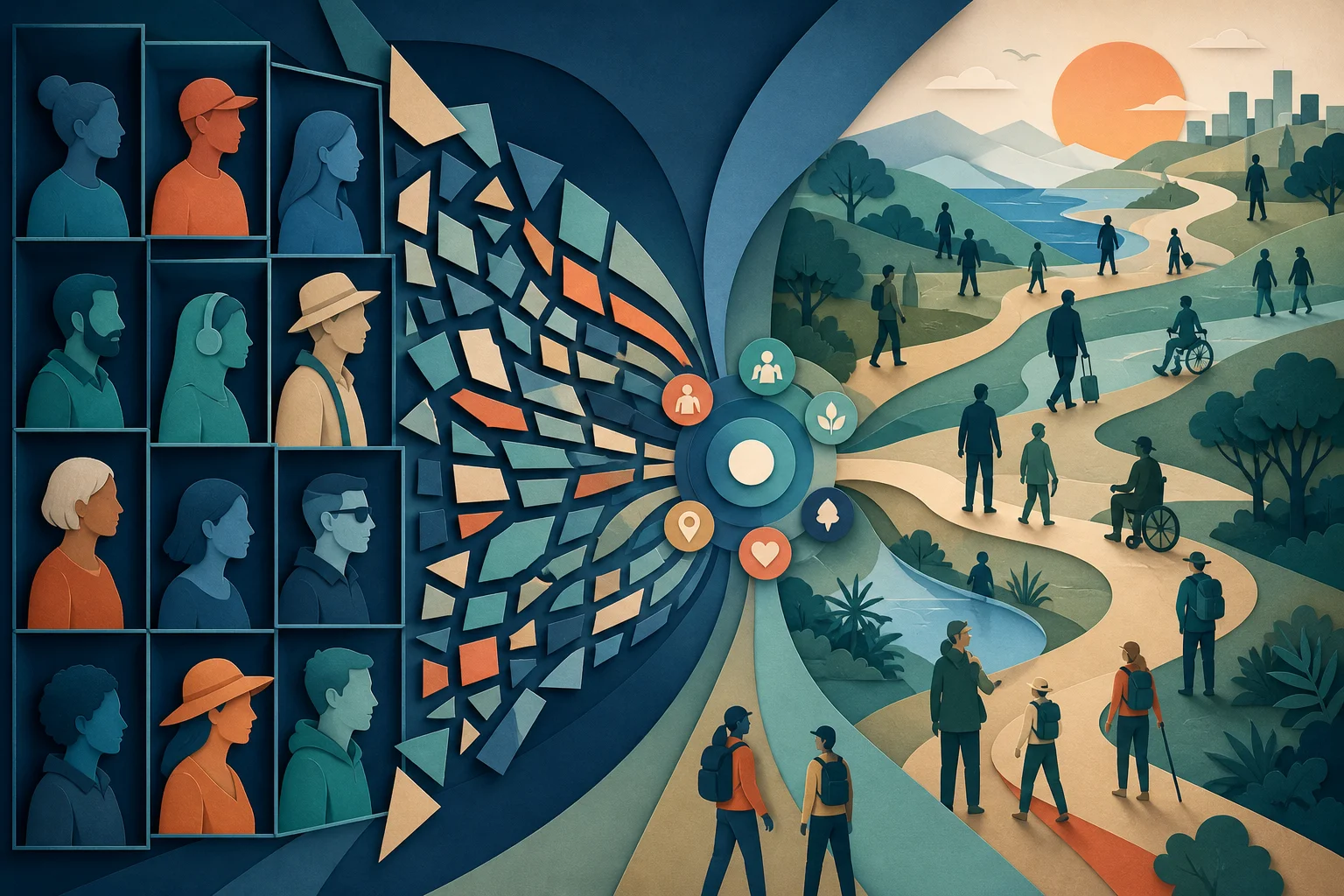
While marketing our destinations and services to conscious travelers is a positive step, it is distracting us from the opportunity to accelerate sustainable development in tourism. We humans aren’t perfect, so isn’t it time we stopped targeting the right traveler and instead started thinking about how we can facilitate a transition away from the wrong behaviors? By addressing tourism behavior, we have the opportunity to encourage ALL travelers, well-intentioned or not, to make choices that are both in the interest of their travel experience and the environment.
In behavioral sciences, we have a treasure chest of knowledge that we are yet to apply to the challenges we are facing in our industry. It’s about using what we know about human nature to design experiences which promote sustainable choices by default, not finding the ‘right’ traveler.
So rather than targeting the small segment of the market prepared to pay for sustainability, how can we start helping all tourists make more responsible choices? In this series of articles about the ‘Right’ Traveler, we’ll introduce some concepts of behavioral sciences, discuss how they can be applied in the tourist context, and offer communication tactics to reveal how industry players big and small can encourage responsible behaviors.
–
In our next article, we’ll look at some of the barriers to change when it comes to tackling existing behaviors, and explore some examples to reveal the impact of applying behavioral sciences can have at different stages of a tourist’s customer journey.