
Legacy article
First Mile Journey: Turning Behavioral Science into an Actionable Program
From towel reuse to energy savings: see how the First Mile turns behavioral insights into everyday actions that cut costs and waste.
- Author
- By Milena Nikolova
- Published
- August 28, 2025
This article was migrated from the BehaviorSMART archive with its original legacy context.
Several years ago, when BehaviorSMART was still a young company taking its first steps, we found ourselves facing a puzzle. We had a treasure chest of insights from behavioral science – fascinating knowledge about how people make choices and how context shapes behavior. We knew how relevant this was to the everyday realities of businesses and destinations. But turning it into a cohesive, hands-on program that could truly engage sector players? That was another story.
At the time, “behavior change” was something tourism professionals found exciting but also mysterious. When I spoke about defaults, nudges, or the intention–action gap at conferences, tourism professionals were intrigued and intellectually engaged. Yet they struggled to see how these ideas could be applied in the day-to-day work of hotels, tour operators, or destination managers.
This prompted many internal discussions about how we could package the principles of behavioral science into a structured, hands-on approach for tourism. It was during one such conversation with my good colleague and early supporter, Bård Jervan from Norway (then at the consulting company MIMIR), that the spark came. I was describing how small tweaks in service design, such as rephrasing a message or redesigning a choice, could shift the behavior of entire groups of visitors. To me, it was obvious, a no-brainer, but when I explained it, it somehow sounded more complicated than it was.
We kept circling back to the same challenge: how do we convey that this is simply the first step in a journey, not an overwhelming reinvention? At one point, I floated the idea of calling it the “first 10%.” It captured the spirit, but lacked… elegance. Then, in that same conversation with Bård, the phrase landed: The First Mile. Short, clear, and with just enough metaphor to spark curiosity. Since that moment, the First Mile has become one of our signature methods, helping businesses and destinations take those catalytic first steps toward embedding sustainable, regenerative, and climate-friendly practices into their offerings.
What Exactly Is the First Mile?
The First Mile is an approach inspired by behavioral science, and specifically by what we know about how behavior change actually happens.
It grew out of our analysis of the notorious intention–action gap, i.e., the frustrating reality that travelers (and workers too) often say one thing and do another. Most guests do not intend to waste energy or generate piles of waste. They simply do what feels easiest, most familiar, or most appealing in the moment. On holiday, when people make dozens of decisions a day – from what to eat to which tour to book – they rarely pause to evaluate the sustainability impact.
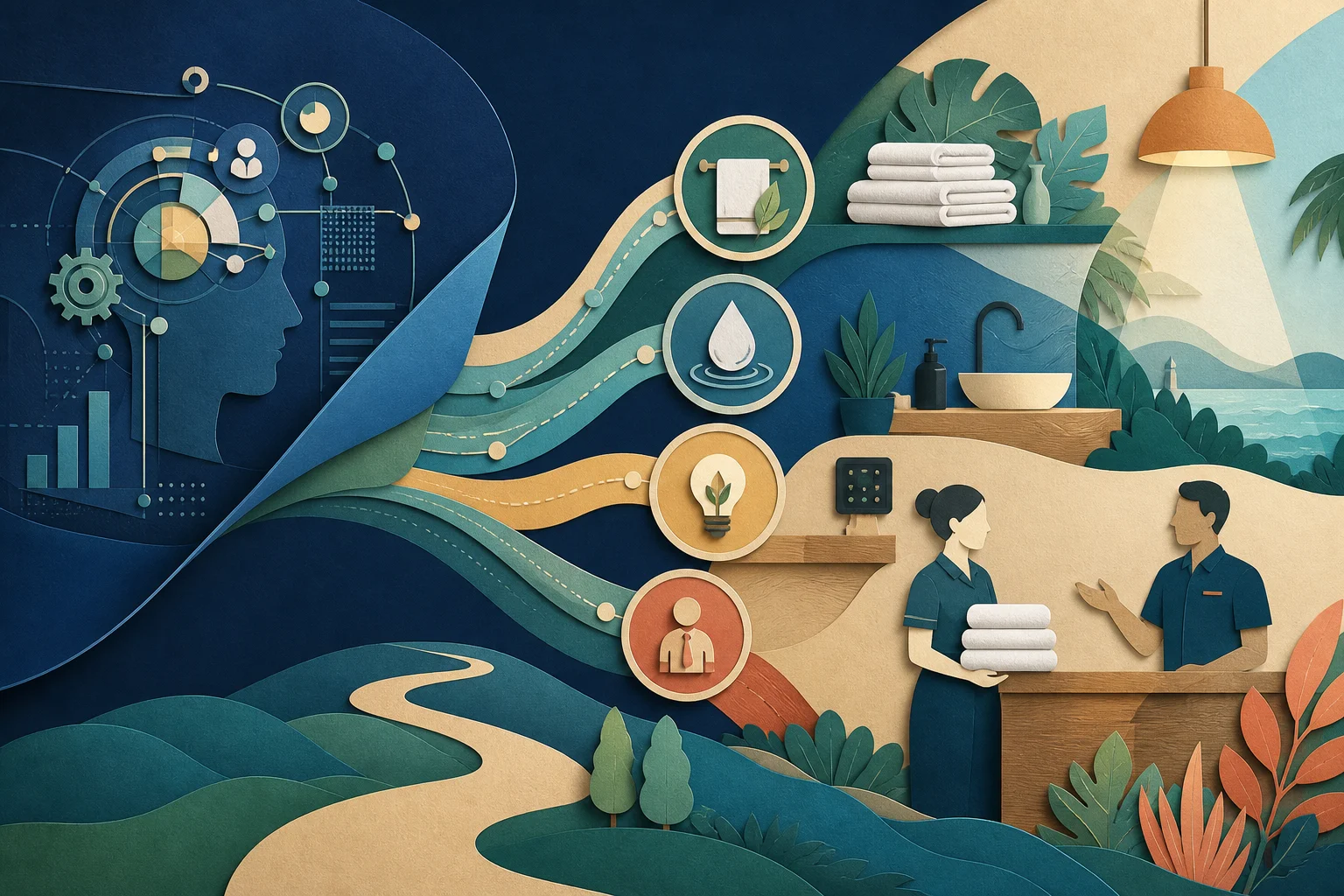
We knew that context matters. Tiny tweaks, like which option is presented first, how it is worded, or what is made default, can dramatically shift outcomes. For example, by moving from daily towel changes to a three‑day default cycle, while still allowing guests to request fresh towels at any time, hotels can slash laundry-related water use almost overnight. A restaurant menu that highlights seasonal local dishes in vivid, sensory language can quickly boost local food orders. There is no need for an extensive education campaign to turn guests into sustainability champions. The effect can be achieved simply by making towel reuse effortless and local dishes sound irresistible to the holiday brain. And these kinds of tweaks could influence all sorts of decisions – from opting for an electric rental vehicle to choosing to explore a city on foot.
Understanding all of this led us to design a program that maps the choice moments where such nudges can be planted and identifies the right tactic depending on whether it is best to employ ease and defaults or to strengthen appeal. This is how the First Mile program was born: a clear, structured methodology that transforms behavioral science insights into actionable design adjustments, delivering efficiency, cost savings, and improved sustainability.
From First Step to Tipping Point
At first, we thought of the First Mile as exactly that: a first step. A way to help businesses ease into behavior-smart cost optimization and sustainability. But over time, we discovered three additional important effects. The first was that sometimes the “minor” steps yielded results that were surprisingly significant:
The second key finding was that businesses that embed smart choice design not only save costs and reduce their footprint, but also enhance the guest experience. We knew from science that people like to feel they are doing the right thing, even if they do not want to put in extra effort to get there, so we suspected that when businesses removed the effort, guests would respond with appreciation. Our partners confirmed that through higher satisfaction scores and more glowing reviews after adopting seemingly minor adjustments.
The third realization was that multiple small, smart changes can combine to produce system-level effects. Tweaks in service design accumulate into tipping points that shift norms. None of these changes required heavy investments or radical reinvention, but together they reshaped what guests perceived as “normal.” When every touchpoint along a trip – from hotel check-in to tour briefing to the dinner menu – gently points in the direction of local, mindful, and low-impact choices, perceptions shift. Responsible behaviors begin to feel like the norm rather than the exception.
That is how we realized that the First Mile is not just a first step. It is a catalyst.
The Journey Begins with a First Mile
When we first formulated the First Mile as a behavior change program, we imagined it as the opening stretch of a marathon. But now, after applying it across several projects in the Nordics and across Europe, we see it more like a winding trail in a beautiful destination: the first mile may be the easiest, but it sets your direction. It determines whether the rest of the journey feels uphill or effortless.
If you are curious to learn more about the First Mile in action, explore the website of the recently concluded NorReg Project, where we used the methodology to make regenerative practices part of the traveler experience across the Nordics. You can also read online about The First Mile Project, which supports 80 small and medium tourism enterprises across France, Italy, Norway, and Slovenia in employing behavior change techniques to pursue sustainability goals such as waste reduction, saving water and energy, encouraging local buying, and avoiding overcrowding. In the coming months, we will release a toolset for businesses with step‑by‑step guidance based on the lessons from this project, making this knowledge available to companies across Europe and beyond. In the meantime, you can follow the project’s LinkedIn page, where we regularly share updates and data on the results companies are achieving.
The bigger picture is that The First Mile has become our way of translating science into a program that makes a real difference in the marketplace. It shows that behavioral insights can be transformed into practical actions that reduce costs, delight guests, and foster smarter, more sustainable tourism, and that clever, seemingly insignificant adjustments in choice architecture can lead to system-wide change.
BehaviorSMART bridges strategy and behavior with activation toolkits that turn good intentions into real impact. Follow our work and explore our resources to learn how behavioral activation becomes the engine of both market success and lasting sustainability.
*This article is human-written; AI tools were used for final edits and confirmation of data sources.