
Legacy article
3 Milestones to Turning Behavior Change into System Change
Discover 3 milestones that turn individual behavior change into system-wide impact for smarter, more sustainable tourism.
- Author
- By Milena Nikolova
- Published
- October 30, 2025
This article was migrated from the BehaviorSMART archive with its original legacy context.
From Individual Success Stories to Systemic Impact
A week ago in Bologna, I found myself in a room buzzing with energy. Eighty tourism and hospitality businesses – hotels, campsites, restaurants, and local experience providers – came together to share what they had achieved through The First Mile, our three-year project testing behavior-smart tactics across real operations and customer contexts.
With the First Mile Project partners: AVITEM/ Open Tourisme Lab / Mimir as / AITR-Turismo Responsabile / Tourism Bohinj DMO / BehaviorSMART, European Innovation Council and SMEs Executive Agency (EISMEA) / EU Business
The results were striking. Some hotels managed to completely shift guest demand toward local options, steering most orders to food and drink sourced from nearby producers. Others eliminated single-use plastics entirely by redesigning how guests were offered water. Campgrounds saw major improvements in waste separation (a challenge often faced by camping complexes), while attractions welcomed more guests arriving on foot or by public transport. As one of the business owners shared:
“It was inspiring to take an unusual and refreshing take on sustainability that not only worked but was good for business. It gave us an aha moment, for sure.”
In all these cases, businesses benefited in multiple ways – reducing costs, enhancing guest satisfaction, and gaining extra appreciation from customers. It was rewarding to see both the data and the stories from companies that appreciated how these improvements came from targeted, behavior-smart adjustments, not from infrastructure overhauls, large educational campaigns, or intensive staff training.
These results gave us something we have long sought: solid and diverse proof that the behavior-smart methodologies we design – grounded in research, inspired by science, and informed by successful practices from other sectors – truly work. So we have the proof, what is next? With this evidence in hand, we have reached a milestone on our journey to applying behavioral change at scale. In fact, BehaviorSMART was founded with the vision of translating behavioral insights into solutions that can reshape systems – programming good behavior across entire company supply chains, industry groups, and destinations.
From a Single Nudge to Systemic Shifts
It is inspiring to see one or two hotels in a town reduce their plastic footprint by steering guests toward tap water. But what if all accommodations in that destination did the same?
What if every restaurant and café used creative nudges to grow demand for local, seasonal dishes in ways that excite guests while also reducing food waste and optimizing operations? What if gamified maps encouraged visitors to explore and spend locally on foot, by bike, or via public transport – cutting carbon emissions, easing congestion, and deepening their connection to the place?
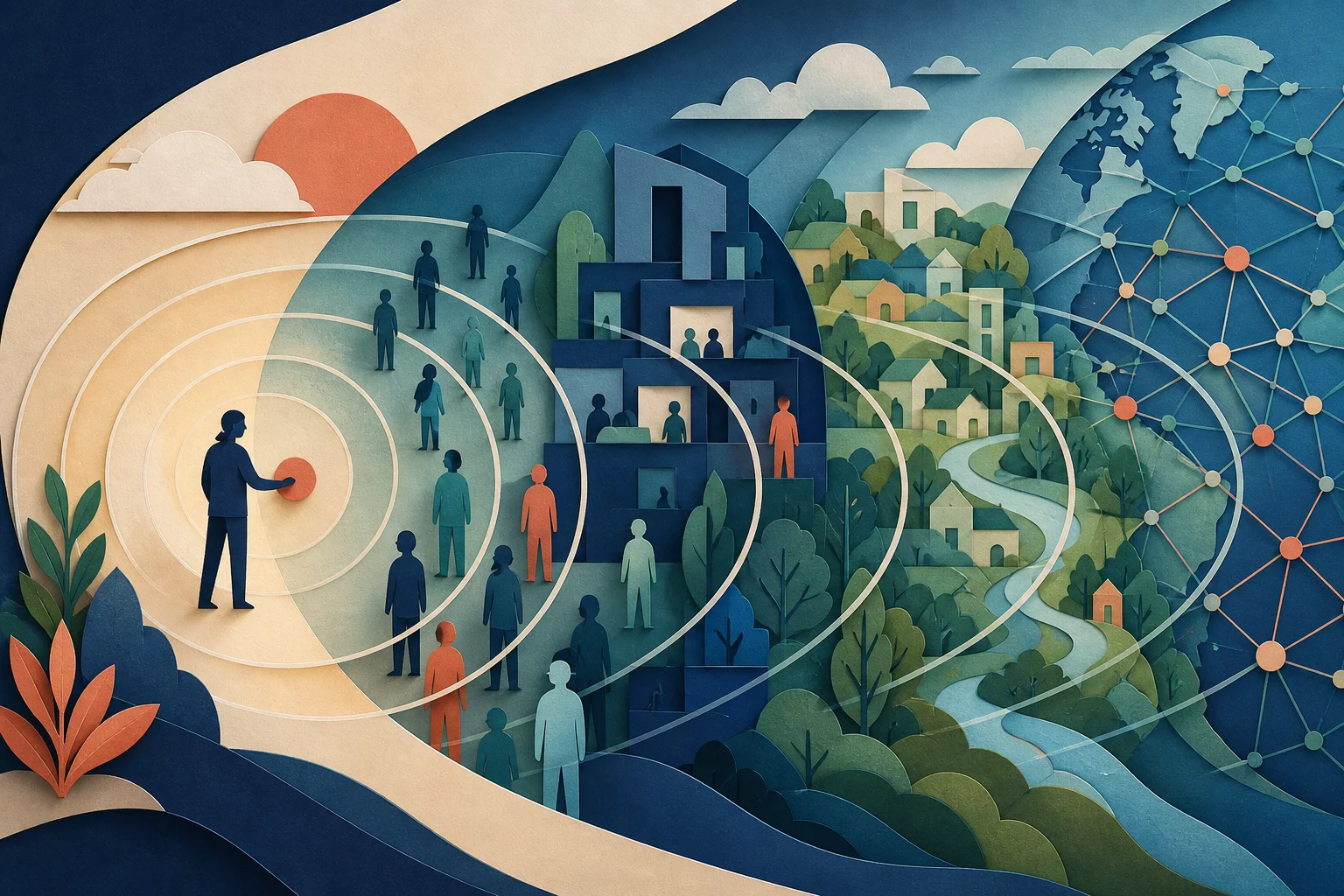
The result would not just be better behavior in isolated spots. It would be a system-wide shift, where the collective design of experiences gently and consistently steers visitors and staff toward smarter, more responsible actions – automatically.
When many actors align around a shared behavioral vision, coordinated design changes across their operations amplify one another. More guests choose sustainable mobility. More meals feature local products. More reusable options replace disposables. Waste declines. Satisfaction rises. The ripple effects strengthen the economic, environmental, and social performance of the entire system, whether that system is a destination, a business group, or a supply chain.
This is what system-level change looks like when powered by behavioral science – shifting behavioral patterns through precise system adjustments rather than overwhelming overhauls.
3 Milestones to Achieve System-Level Change
We are now on the doorstep of something even more exciting – scaling behavior-smart approaches to the system level. This is where we hope to make a real impact in the near future. We know that businesses and destinations are already employing individual nudges and adjusting service designs here and there, but executing an effort that reprograms behavior across an entire system has been our long-standing ambition – and one we believe can make a big difference. We are ready for it, and as we gear up for this next stage, we foresee three essential milestones that can turn a collection of individual actions into a coordinated transformation.
Milestone 1: Find the Shared Win
Begin by identifying a priority behavior that benefits everyone involved – the different businesses, supply partners, DMOs, and travelers themselves. The gains must be appealing and practical, creating shared value rather than competing agendas.
Reducing waste cuts costs and simplifies logistics. Highlighting local, seasonal menus enhances guest experience while supporting producers. Encouraging sustainable mobility improves visitor flow and reduces emissions while giving guests a richer sense of place.
When the desired change produces tangible benefits for each participant, collective motivation emerges naturally. Shared wins build shared commitment.
Milestone 2: Map and Align the Choice Points
Next, identify all choice points that influence the desired behavior – the physical and digital moments when people decide what to do.
At physical points of choice (hotel rooms, restaurants, attractions) behavioral design can guide action through wording, option order, placement, timing, or visual cues. In digital environments (booking platforms, AI travel assistants, digital maps) the same principles apply: defaults, prompts, and personalized recommendations can steer travelers toward responsible options seamlessly.
The real magic happens when these layers work together. Imagine a visitor who pre-orders a local meal online, finds it highlighted as the “chef’s favorite” on the restaurant menu, and later receives directions to visit nearby producers via a smart map. The coordination of digital and physical design multiplies the behavioral effect – and that is the power of system-level design.
Milestone 3: Measure the Ripple Effect
To sustain momentum, system-level change must be visible. Tracking collective progress turns invisible shifts into evidence and motivation.
Depending on the focus, good measures might include:
- the share of local food or products purchased across the network,
- the proportion of guests walking, cycling, or using public transport,
- the percentage of waste successfully separated or avoided, or
- reductions in energy or water use per guest night.
Choosing one or more system-level indicators allows everyone to see how their contribution adds up. Progress data can also be gathered individually and then aggregated for the system, or tracked at the destination level using available datasets. With contemporary analytics tools, dashboards, and tracking systems, options abound. What matters most is consistency and visibility: the shared sense that change is real and measurable.
When Alignment Drives Real Change
We have learned that when multiple actors make targeted, well-coordinated adjustments in the same direction, systems begin to transform. This approach does not depend on regulation or major campaigns; it leans on human realism – the understanding that people change behavior when their environment makes the right choice easy, obvious, and rewarding.
Whether it is a destination system involving a network of local providers or a business system spanning multiple properties, brands, or supply chain actors, both can apply these milestones to create alignment, efficiency, and measurable impact.
A single nudge can change one hotel. A coordinated network of nudges across physical and digital touchpoints can change how an entire system behaves.
The Next Frontier
Behavior-smart design has proven its value for individual businesses. Now it is time to take the next leap – to scale its effects across destinations, business ecosystems, and networks. By aligning many actors and embedding behavioral design into both physical and digital environments, we can unlock the next generation of efficiency, sustainability, and guest satisfaction.
At BehaviorSMART, we are looking for bold partners – destinations, business groups, and networks eager to pioneer this next stage. Let’s build on the success and evidence already achieved together and pilot system-level projects that show how entire ecosystems can shift toward better behavior by design.
Together, we can make doing better the most natural thing guests, staff, and partners do – everywhere.
BehaviorSMART bridges strategy and behavior with activation toolkits that turn good intentions into real impact. Follow our work and explore our resources to learn how behavioral activation becomes the engine of both market success and lasting sustainability.
*This article is human-written; AI tools were used for final edits and confirmation of data sources.